No One in the Room Looks Like You: The Hidden Crisis in Desi Mental Health Care
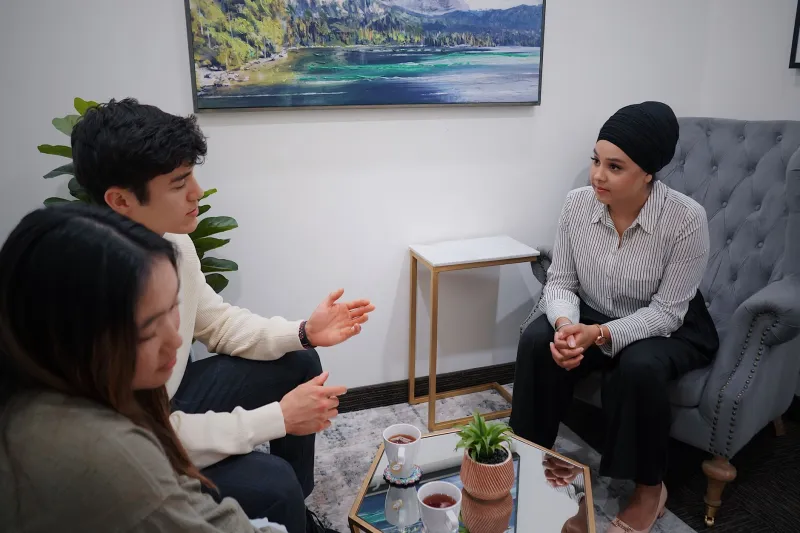
For a long time, the loudest barrier between South Asian Americans and therapy was the word itself. Saying you needed help felt like admitting something shameful — a failure of family, of resilience, of the immigrant grit that supposedly got everyone here in the first place. That wall has been chipping away, slowly, loudly, and with a lot of Instagram infographics. But as more desi folks finally push open the door to mental health care, they're running into something nobody really prepared them for: the therapist they actually need might not exist in their zip code. Or their state. Or, sometimes, anywhere with a reasonable waitlist.
The South Asian therapist shortage isn't a rumor. It's a structural gap that sits quietly at the intersection of cultural stigma, professional gatekeeping, and the very real economics of graduate school debt — and it's leaving diaspora communities in a frustrating bind.
Why Desi Representation in Mental Health Lags So Far Behind
Look at any list of professions where South Asian Americans are overrepresented, and you'll find the usual suspects: medicine, engineering, finance, law. Therapy? Not so much. And the reasons aren't random.
For many first-generation families, a career in mental health registered as neither prestigious nor financially stable enough to justify the sacrifice it took to build a life in America. The message, spoken or not, was clear: you can go to a therapist (maybe, quietly, if things got really bad), but you do not become one. The social capital just wasn't there.
That calculus has consequences. Today, South Asians make up roughly 1.4 percent of the U.S. population — a number that has grown significantly over the last two decades — but their representation among licensed therapists and clinical psychologists is vanishingly small. Exact figures are hard to pin down because mental health workforce data doesn't always break out South Asian identity specifically, but anecdotal evidence from practitioners and patients paints a consistent picture: the wait to see a culturally competent desi therapist can stretch from weeks into months.
What "Culturally Competent" Actually Means Here
It's a phrase that gets thrown around a lot, but it carries real weight in this context. For South Asian clients, cultural competence isn't just about a therapist recognizing that Diwali exists. It's about understanding the architecture of a desi household — the layered expectations, the specific texture of intergenerational pressure, the way guilt and love can occupy the exact same sentence when your mom calls.
It means not having to spend the first three sessions explaining why you can't just "set a boundary" with your parents the way a self-help book suggests. It means a therapist who gets that your anxiety about your career isn't just personal ambition — it's tied to your family's immigration story, to a sacrifice you witnessed but didn't choose. It means not feeling like an anthropological subject in your own therapy room.
General diversity training helps, but it doesn't fully close that gap. And many desi clients who've tried working with non-South Asian therapists — even well-meaning, culturally curious ones — describe a low-grade exhaustion of constant translation. Not linguistic translation. Emotional translation.
The Ones Who Are Out There Are Drowning in Demand
Here's the irony: just as cultural stigma around therapy has started to soften, the desi therapists who built practices specifically to serve South Asian communities are completely overwhelmed. Many have closed their waitlists entirely. Others are booked six months out. Some have shifted to group therapy formats or psychoeducation workshops just to reach more people without burning themselves out.
The demand surge isn't mysterious. Pandemic-era mental health crises hit desi households hard — isolation amplified family conflict, immigration uncertainty spiked anxiety, and a generation of second-gen young adults started naming things their parents never had language for. At the same time, social media made it easier to find desi therapists by name, which concentrated demand on a very small pool of practitioners.
The result is a bottleneck that no amount of awareness campaigns can solve on its own.
What's Actually Being Done — and What Needs to Happen
There are green shoots. A handful of organizations have started explicitly recruiting South Asian graduate students into clinical psychology and social work programs, framing mental health careers as a form of community service rather than a professional compromise. Some desi therapist collectives have launched sliding-scale telehealth options specifically targeting diaspora clients who can't find anyone locally.
Telehealth, in particular, has been quietly transformative. Being able to see a South Asian therapist licensed in another state — without geography as a barrier — has opened access in ways that the traditional in-person model never could. A desi woman in suburban Ohio can now have a weekly session with a therapist based in New Jersey who grew up in a Gujarati household and doesn't need a primer on joint family dynamics. That's not nothing.
But telehealth alone won't fix the pipeline problem. Graduate programs need to actively diversify their recruitment. Mental health organizations need to stop treating "South Asian" as a subheading under "Asian American" and start treating it as a distinct clinical and cultural context with its own specific needs. And frankly, desi communities need to start visibly celebrating the people who go into this field — the same way a doctor's graduation gets a party, a new therapist's licensure deserves one too.
The Cost of the Wait
None of this is abstract. When someone finally decides they're ready to get help — after years of talking themselves into it, after overcoming the family voice in their head that says this is weakness — being told there's a six-month wait can be enough to make them give up entirely. That's the real cost of the shortage. Not inconvenience. Retreat.
The desi mental health movement did something remarkable: it made it okay to ask for help. The next chapter has to be making sure the help is actually there when people go looking for it. Because a movement that changes the conversation but not the infrastructure is only half a revolution.