The Good Girl Breaking Point: What's Really Happening Inside High-Achieving Desi Households
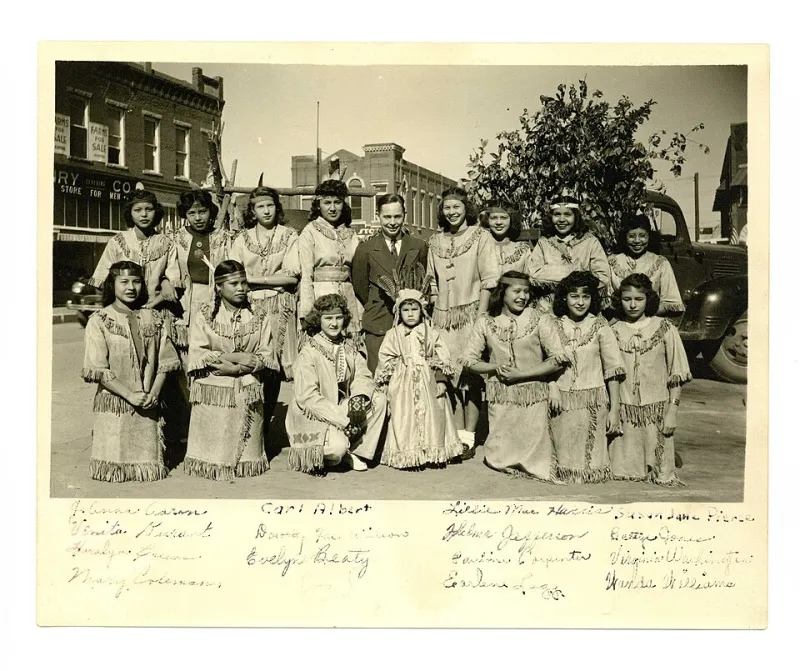
Photo: SMU Central University Libraries, No restrictions, via Wikimedia Commons
She's the one everyone points to at family gatherings. The daughter who got into a top-ten school, who speaks respectfully to elders, who never gave her parents a hard time. She's the proof that immigration worked, that sacrifice meant something, that the American dream delivered.
She's also, in a growing number of cases, completely burned out before she turns 25.
This is the story that doesn't get told at dinner parties. It doesn't show up in the proud Facebook posts about college acceptances or the wedding announcements with professional photos. It lives in therapy waiting rooms, in tearful late-night phone calls, in the quiet devastation of a panic attack in a university library bathroom.
And it's time we actually looked at it.
The Weight of the 'Model Minority'
The model minority myth has always been a double-edged compliment — the kind that flatters a community while erasing everything complicated about it. The idea that Indian Americans are uniformly high-achieving, financially stable, and emotionally resilient isn't just inaccurate. It's actively harmful, because it makes struggle invisible.
When your community is held up as proof that hard work always wins, there's no room to admit that you're not okay. Failure doesn't just feel personal — it feels like a betrayal of every relative who sacrificed something to get you here.
Dr. Anjali Mehta, a licensed psychologist in the DC metro area who specializes in South Asian mental health, has watched this play out with clients for over a decade. "The pressure isn't just coming from parents," she explains. "It's internalized. These young people have absorbed the message so completely that they're now their own harshest critics. They don't need their parents to push them anymore — they do it to themselves, constantly."
The clinical term for this is maladaptive perfectionism. The desi term is just... Tuesday.
What's Actually Being Said at the Dinner Table
To understand the mental health landscape in Indian American homes, you have to understand the particular language that gets spoken — and the language that doesn't.
Feelings, in many traditional desi households, are treated like houseguests who weren't invited. You acknowledge them briefly and then you find something productive to do. Sadness is met with "just focus on your studies." Anxiety becomes "you're overthinking." Depression, if it surfaces at all, is reframed as laziness or ingratitude.
Therapy, historically, has been viewed with deep suspicion. Going to a therapist means something is seriously wrong. And if something is seriously wrong, it might reflect on the family — which is, in the calculus of many desi households, the worst possible outcome.
Amara Krishnan, 24, a second-year law student in New York, described the dynamic with striking clarity. "In my house, there was always this unspoken rule: whatever you're feeling, you deal with it privately and you show up. You don't burden other people. You definitely don't go talk to a stranger about it." She paused. "I had a full breakdown during my LSAT prep and didn't tell my parents for eight months."
Eight months. Sitting across from them at dinner, fielding questions about her practice scores, saying she was fine.
The 'Good Girl' Trap
There's a specific version of this pressure that lands harder on young women in the community. The expectations are layered in a way that can feel impossible to escape: excel academically, maintain a certain appearance, be emotionally available to the family, don't be too loud or too opinionated, and do all of this while making it look effortless.
The effortlessness part is crucial. Visibly struggling is almost more transgressive than actually failing, because at least failure can be explained. Struggling means you can't handle it — and desi girls are supposed to be able to handle it.
This shows up in how Indian American women are represented on screen, too. When they do appear in American TV and film, they're often the overachiever, the responsible one, the girl with the plan. Rarely are they allowed to be a mess. Rarely do they get to fall apart and have it be the whole point of the story, not just a plot obstacle.
The cultural visibility gap matters more than it might seem. When you never see your specific brand of burnout reflected back to you — not in your family, not in your community, not on your screen — it's very easy to conclude that you're the only one. That something is uniquely, privately wrong with you.
What's Actually Changing
Here's the part that carries some genuine hope: things are shifting, even if slowly.
Mental health content aimed specifically at South Asian audiences has exploded on social media over the last few years. TikTok and Instagram accounts run by desi therapists and advocates have built enormous followings precisely because they're naming things that weren't being named. Comments sections on these posts read like confessionals — thousands of young Indian Americans typing "I thought I was the only one" in response to a 60-second video about immigrant parent emotional dynamics.
Dr. Mehta has noticed a change in who's walking through her door, too. "I'm seeing more young people who came in on their own, without a crisis forcing them. That's genuinely new. Five years ago, most of my South Asian clients came in because something had already fallen apart. Now some of them are coming in proactively, which tells me the stigma is cracking, even if it hasn't broken."
Parents are shifting, too — not uniformly, and not fast, but in ways that are visible if you know where to look. Some families, particularly those with more exposure to American mental health culture through workplaces or media, are starting to use the vocabulary. Starting to ask different questions.
Rohan Patel, 26, from Atlanta, said his dad surprised him last year. "He literally sent me a link to a meditation app. Like, he found it somewhere and thought of me. That would have been unthinkable five years ago." He laughed, but not unkindly. "Progress, I guess."
The Story We Haven't Seen Yet
The mental health conversation in Indian American communities is, in many ways, exactly what Andekha is about — a story that exists, that's real, that's been lived by thousands of people, but that hasn't fully been seen yet. Not by mainstream media, not always by the community itself.
Naming it doesn't fix it. But it's where everything else starts.
If you're the good girl who's running on empty, or the high-achiever who can't remember the last time they felt okay, or the kid who's been performing fine for so long they've forgotten what fine actually feels like — you're not alone, and you're not broken.
You're just carrying something heavy. And maybe, finally, you don't have to carry it alone.