Mehndi Optional: How Young Desi Couples Are Blowing Up the Big Fat Indian Wedding
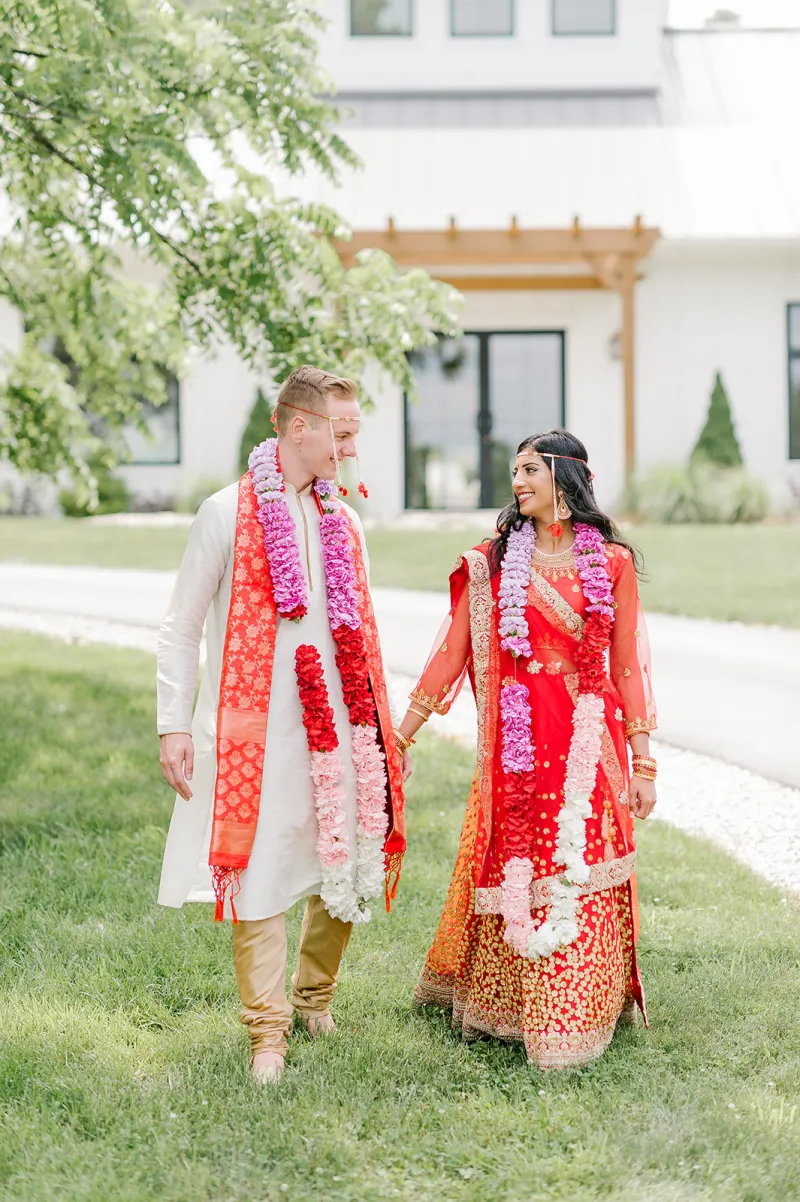
Photo: intimate Indian American wedding ceremony small outdoor gathering couple in traditional attire, via thewildsvenue.com
If you've been to an Indian wedding in the last decade, you know the format. Day one: mehendi, maybe sangeet. Day two: ceremony. Day three: reception. Somewhere in there, a minimum of four outfit changes, a choreographed dance number performed by at least one reluctant uncle, and a catering bill that makes everyone briefly reconsider the whole institution of marriage.
Now picture something different. A backyard in Austin. Twenty-seven people. A pandit on a laptop screen. A bride in a rust-colored lehenga she found on Depop. A groom in a kurta he actually picked himself. Vows that took three months to write. A playlist that goes from Arijit Singh to Frank Ocean without warning.
This is also an Indian wedding now. And more couples are choosing it.
The Math Stopped Making Sense
Let's start with the money, because it's impossible not to. The average Indian-American wedding in the US costs somewhere between $65,000 and $100,000, with elaborate affairs in major metros running significantly higher. For a generation already managing student loans, inflated housing costs, and a general sense of economic precarity, that number has started to feel less like a celebration and more like a hostage situation.
"We looked at the quotes and just... laughed," says Priya, 27, who got married last spring in a small ceremony outside Philadelphia with 40 guests. "The venue alone was going to cost more than my annual salary. And for what? So people we've met twice can eat buffet chicken tikka masala and leave by 10pm?"
Her parents were not initially amused. Her mother-in-law was even less so. But Priya and her husband held firm, and what they ended up with — a two-hour ceremony followed by a long dinner at a restaurant they actually love — is something she describes as "the most us thing we could have done."
That phrase keeps coming up in conversations with young desi couples reimagining their weddings: the most us thing. It signals a fundamental shift in what a wedding is supposed to be for.
Tradition Isn't the Enemy — Performance Is
Here's what's worth clarifying: most of the couples opting out of the mega-wedding aren't opting out of Indian tradition entirely. They're opting out of the performance of tradition — the version that exists primarily to be witnessed, photographed, and reported back to extended family networks across three continents.
Many are keeping the rituals that genuinely mean something to them and letting go of the ones that feel obligatory. A saptapadi, yes. A DJ set that runs until 2am to justify the ballroom booking, no. Marigolds and diyas because they're beautiful, not because someone's aunty will notice if they're missing.
"I think there's a difference between honoring your culture and staging it," says Vikram, 29, who married his partner Sasha — who is half-Korean, half-white — in a ceremony in Brooklyn that wove together Hindu, Korean, and secular elements. "We wanted the parts that felt true. We didn't want a production."
Their ceremony lasted 45 minutes. Their reception was a dinner party. Their wedding photos look nothing like the glossy, heavily filtered spreads you see in South Asian bridal magazines. They're better.
The Generational Standoff
None of this is happening without friction. The pushback from parents and extended family can be intense, and it often carries real emotional weight — not just preference, but grief. For many first-generation immigrant parents, a big wedding isn't vanity. It's visibility. It's proof of arrival, of success, of a life built in a new country that turned out to be worth it.
Understanding that doesn't make the conversation easier, but it reframes it. "My mom wasn't upset because she wanted a party," says Meera, 26, who eloped in Colorado last fall and held a small dinner for family afterward. "She was upset because she had imagined this moment for 26 years. I had to grieve that with her, not just tell her to get over it."
Therapists who work with South Asian families say this is one of the more nuanced generational conflicts they're seeing right now — because both sides have legitimate feelings, and neither is simply wrong. The question is whether couples can hold their ground while genuinely making space for their parents' emotions. Not everyone manages it gracefully. But many do.
The Wedding Industry Is Paying Attention
Where couples go, money follows, and the wedding industry — always a reliable indicator of cultural shifts — is scrambling to keep up. South Asian wedding planners who built their businesses on the three-day extravaganza model are quietly adding "intimate ceremony" and "microwedding" packages to their offerings. Bridal designers are producing smaller, more wearable collections alongside the showpiece pieces. Photographers are pitching editorial, documentary-style packages to couples who want real moments over posed grandeur.
Even the big bridal media platforms are noticing. Features on "intimate desi weddings" and "non-traditional shaadi inspiration" have started appearing in spaces that used to exclusively celebrate maximalism.
It's not that the big wedding is dead — it very much isn't. There are still plenty of 500-person affairs happening every weekend across New Jersey, Houston, and the Bay Area, and they are spectacular. But they are no longer the only option that gets taken seriously.
What They're Actually Building
Strip away the trend piece framing for a second, and what you're really looking at is a generation trying to figure out how to begin a marriage in a way that feels honest. Not performative. Not optimized for the guest list. Not a production designed to satisfy every stakeholder in a family network.
Just two people, the people they love most, and a commitment they actually mean.
That's not a rebellion against Indian culture. If anything, it's a pretty Indian idea — that the sacred stuff should be protected, not put on display. The marigolds are still there. The vows are still there. The love, hopefully, is still very much there.
The DJ who plays till 2am, though? He can stay home.