When Mom Goes Viral: The Complicated Joy of Putting Your Desi Family on the Internet
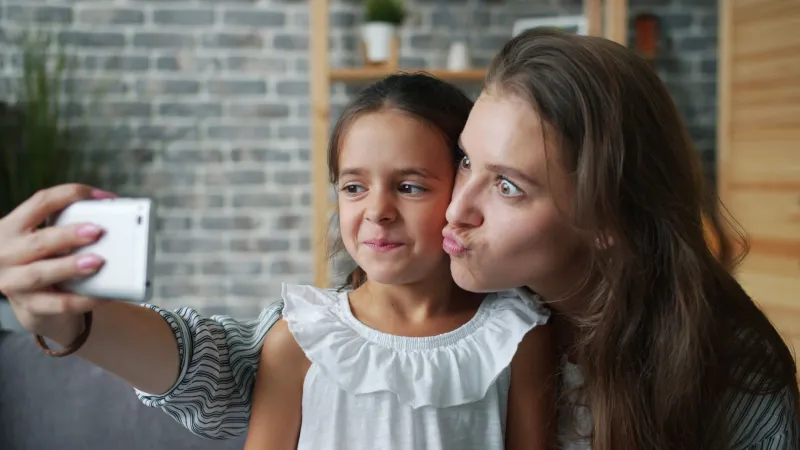
The video opens with a familiar setup. A twenty-something Indian American woman is on the phone with her mother. The mother is asking, in rapid-fire succession, whether she's eaten, why she hasn't called, whether her roommate is a good influence, and when she plans to get married. The daughter responds in exhausted monosyllables. Three million people have watched it.
This is a genre now. Call it Desi Mom Content — a category of Indian American creator output so consistent and so popular that it has its own visual vocabulary, its own recurring jokes, its own emotional arc. And like most things on the internet that look effortless, it's considerably more complicated than it appears.
The Character Everybody Recognizes
The Desi mom as comedic figure isn't new. She's been in Bollywood films for decades — the one who cries at airports, who measures love in food portions, who has a network of aunties that functions as a surveillance system. What's new is the medium, and the intimacy it creates.
When creators like Sejal Kumar, Liza Koshy in her earlier work, or the dozens of smaller creators building audiences on Instagram Reels and TikTok bring their actual mothers into content, something shifts. It's not just a character anymore. It's a real person, often one who came to this country with very specific ideas about privacy, family reputation, and what it means to be seen.
The content tends to land because it's specific in ways that feel universal to the diaspora. The accent rendered lovingly and accurately. The particular logic of "log kya kahenge" — what will people say — applied to choices that have nothing to do with other people. The food as love language, the guilt as love language, the everything as love language. Desi viewers watch these videos and feel, often for the first time, that their family dynamics are being reflected back at them on a mainstream platform.
The Ethics Nobody's Talking About
Here's the question that sits underneath all of it: did she consent?
Not just in the legal sense — though that matters — but in the full, informed, ongoing sense of the word. Does the immigrant mother who agreed to appear in a funny video for her daughter's "social media thing" understand that the video will be watched by three million people? That it will be screenshotted and reposted? That her accent, her phrasing, her particular brand of over-involvement will become, for a significant audience, the definitive image of what a Desi mom looks like?
Some creators are thoughtful about this. They involve their parents in the process, share content before posting, have genuine conversations about boundaries. Others, frankly, aren't. The parasocial relationship between audiences and creators has a way of making everything feel casual, including decisions about other people's privacy.
"My mom loves the attention," one creator told us, laughing. Then she paused. "I mean, I think she does. We've never really talked about it seriously."
That gap — between assuming and actually asking — is where things get complicated.
When the Joke Cuts Both Ways
There's a version of Desi Mom Content that's genuinely affectionate — creators who are clearly celebrating their mothers even while poking fun, whose videos end with warmth, whose audiences leave the comment section feeling good about immigrant parents everywhere.
And then there's a version that's less generous. The "cringe" content. The setups where the mother is the punchline, where her values are framed as backward, where the joke only works if the audience agrees that she's a little embarrassing. This content also gets views. Sometimes more views.
For Desi audiences, this distinction matters enormously. There's a long history of immigrant communities watching their parents get laughed at by the dominant culture — the accent mocked, the customs treated as exotic, the food described as smelly. When that mockery comes from within the community, repackaged as relatable content for a Gen-Z audience, it lands differently. Some find it liberating. Others find it a little too familiar in a way that doesn't feel good.
"I've seen videos where the mom is clearly trying to be a good sport and the creator is just... using her," says one viewer who asked to remain anonymous. "And the comments are like 'omg my mom is exactly like this' but they're laughing at her. That's not representation. That's something else."
The Moms Who Became the Main Character
Not every story here is cautionary. Some immigrant mothers have become genuine digital personalities in their own right — women in their 50s and 60s who started as supporting players in their children's content and ended up with their own followings, their own brand deals, their own sense of what they want to say to an audience.
There's something genuinely moving about watching a woman who spent decades in relative cultural invisibility — working, raising children, navigating a country that didn't always make her feel welcome — suddenly find an audience that's hungry for exactly what she has to offer. Her recipes. Her opinions. Her completely unfiltered take on her daughter's apartment.
These women aren't victims of their children's content strategies. They're participants, and increasingly, collaborators.
The Representation Question
Zoom out, and what you're looking at is a generation of Indian American creators who are, largely for the first time, producing mass-scale content about Desi family life on their own terms. The stories being told aren't filtered through a Hollywood writers' room or a network executive's idea of what's relatable. They're coming directly from people who lived them.
That matters. Even when the execution is imperfect, even when the ethics are murky, the fact that Desi family dynamics are being represented at scale — with specificity, with humor, with actual knowledge of what it feels like — is meaningful.
The question worth keeping in front of us isn't whether this content should exist. It should. The question is whether the people at the center of it — the mothers, the aunties, the dads who occasionally wander into frame — are partners in the story or props in someone else's.
The best creators already know the answer. The rest are figuring it out, one viral video at a time.