Scalpel Down, Paintbrush Up: The Desi Professionals Quietly Choosing a Different Life
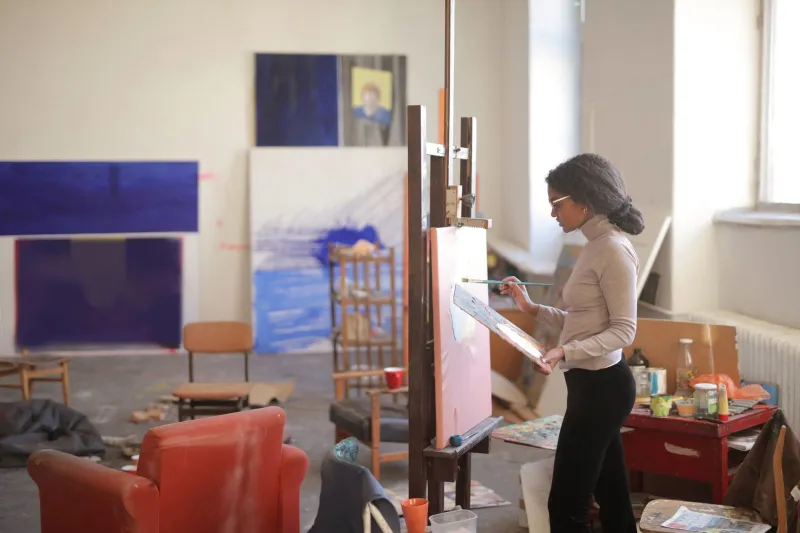
Priya Menon spent six years training to become a cardiologist. She survived the MCAT, survived medical school, survived a brutally competitive residency in Chicago. Then, at thirty-one, she published a short story in a literary journal, and something cracked open. Eighteen months later, she was writing full-time.
"My mom still tells people I'm 'on a break from medicine,'" Priya laughs. "It's been four years."
She's not alone. Across the country, a quiet rebellion is unfolding inside desi households — one that doesn't announce itself with a dramatic confrontation at the dinner table, but rather through a series of small, deliberate choices. The second generation of Indian Americans, many of them raised on the sacred trilogy of doctor-engineer-lawyer, are increasingly choosing something else entirely: music, visual art, writing, film, design. Careers that, not too long ago, felt genuinely unthinkable.
The Math That Used to Add Up
For the first wave of Indian immigrants who arrived after the 1965 Immigration and Nationality Act, the calculus was simple and completely rational. You left behind a country with limited opportunities, you came to America with a degree in hand, and you built something stable. Stability meant medicine. It meant engineering. It meant your kids would never have to worry the way you worried on that first flight into JFK.
That logic held for a generation. It produced remarkable outcomes — Indian Americans today represent one of the most highly educated and economically successful immigrant communities in the country. But success has a funny way of dismantling its own urgency. The very security those first-generation parents built is now giving their children the luxury of risk.
"My parents sacrificed so I wouldn't have to struggle," says Rohan Iyer, a former software engineer at a major Bay Area firm who now runs a music production studio in Los Angeles. "But struggling for something you love is different from struggling to survive. I don't think they fully clocked that distinction until they saw what I was building."
Rohan's parents came around. A lot of parents are, slowly, reluctantly, and sometimes only after their kid's creative career starts generating actual income. Which, more often than not, it does.
The Permission Slip Nobody Signed
What's changed isn't just economic security. It's visibility. The desi creatives who came before — the Mindy Kalings, the Riz Ahmeds, the Hasan Minhajs — didn't just build careers. They built proof of concept. They demonstrated, publicly and loudly, that brown kids from immigrant families could make art that resonated, that won awards, that filled arenas.
Nikhil Sharma, a muralist based in Brooklyn who spent three years as a structural engineer before picking up a spray can professionally, puts it plainly: "When I was growing up, I didn't have a single example of someone who looked like me doing what I wanted to do. Now my fourteen-year-old cousin has, like, forty."
Social media accelerated this. Instagram, TikTok, and YouTube have created economic models for creative work that didn't exist when today's thirty-somethings were making their college decisions. A desi musician with a hundred thousand followers has a career path that's legible in a way that "I want to be an artist" simply wasn't in 2005.
The Guilt Doesn't Disappear — It Just Gets Quieter
Let's not romanticize this too much. The transition isn't painless. Nearly every person who made this leap describes a sustained period of guilt — not because their parents explicitly punished them, but because the weight of expectation is its own kind of pressure.
"I cried in my car a lot," admits Kavya Nair, a visual artist in Austin who spent two years as a pharmacist before pivoting. "Not because anyone was mean to me. Just because I felt like I was breaking something. Like I was wasting what they'd given me."
Therapists who work with Indian American clients note this pattern frequently. The guilt isn't really about the career. It's about the story — the narrative of sacrifice and gratitude that runs through so many desi families like a current. Choosing a creative life can feel, at first, like rewriting that story in a way that dishonors the original authors.
But here's what's interesting: many of these professionals describe eventually finding a way to honor both stories at once. Priya uses her medical background to write fiction that explores healthcare through a uniquely informed lens. Rohan's engineering precision shapes how he approaches music production. The "wasted" degree, it turns out, rarely goes to waste.
What This Means for Desi Identity Going Forward
There's a broader cultural conversation happening here, one that goes beyond individual career choices. When Indian Americans begin populating creative industries in meaningful numbers, they change what those industries produce. The stories told, the music made, the art created — it all starts to reflect a wider range of human experience.
And for the desi community itself, the shift matters too. Identity, for so long tied to professional achievement and social status, gets to expand. Being Indian American no longer has to mean being the doctor at the party. It can mean being the one who wrote the song playing in the background.
"I think my parents finally get it," Priya says. "Not because I convinced them. But because they read something I wrote and they cried. And they realized — oh, this is also something. This also matters."
Maybe that's the real story here. Not a rebellion, exactly. More like a renegotiation. The terms of success, slowly, generation by generation, getting a little more honest.